
7 things I learned from a slipped (herniated) disc
As is often the way, as soon as we take a holiday, we get ill. Whether it’s fighting a cold or flu, or in my case a herniated disc impinging the C7 nerve root sending debilitating pain down my arm. Merry Christmas!
I feel some embarrassment, as a professional who helps others with pain and preaches self-care, that I ended up in this situation.
But of course, life happens. And we all know it’s much easier to give advice than follow our own. This experience has been humbling; I can more fully appreciate the pain of those who walk through my door, and I see how I’ve taken my own body for granted.
Finding help over Christmas was a challenge, and navigating the healthcare system was certainly eye opening. Here’s what I learned:
1. The body is always communicating and if we don’t listen it gets louder
It’s obvious but it’s so easy to ignore the signals or put off looking after ourselves until a more convenient time. In August I noticed a weird pain in my forearm on a drive to Suffolk. It was a sensation I hadn’t felt before and probably should’ve raised more concern.
Perhaps it had been there a while but I was only noticing it because I had time off and the “space” to notice. The following week, though the pain had gone, my back went into spasm. Again, this was a first but once the tightness eased off I continued on at my usual pace.
These were signals from my body to slow down and make more time for self- care, but I wasn’t listening.
2. “One and done” gets limited results
Well, I didn’t ignore the warnings completely. I had a wonderful Craniosacral Therapy treatment with my colleague Carol Mather, which illuminated emotional factors playing into my physical symptoms. I also had Myofascial Release treatment, and both therapies helped my body feel more at ease.
Great! I thought. I am healed. Of course when I’m working with clients, I’m aware that long-standing issues are rarely completely resolved in one session, so I don’t know why I thought I would be an exception.
Regular treatment enables tension in the body to be released by working gradually to deeper layers. The tension that caused my neck injury would’ve taken months, possibly years to build up, so it wasn’t going to disappear after two hours of manual therapy (and it didn’t).
3. In-person consultations and diagnostic touch is crucial
When the pain got worse over Christmas, I found a local osteopath for an emergency appointment. Palpating my neck, she felt inflammation around C6 / C7 and suspected a herniated disc.
The following week I saw a GP to rule out anything else that might be at play. They didn’t touch the areas causing pain but agreed my symptoms matched that of a disc injury, but could also be shoulder bursitis or carpal tunnel syndrome. I would need a scan to confirm.
They offered pain killers and suggested changing hormones may be responsible for my pain, and the reason the pain was worse at night when I was lying down, was likely just my perception. Needless to say I found this frustratingly dismissive.
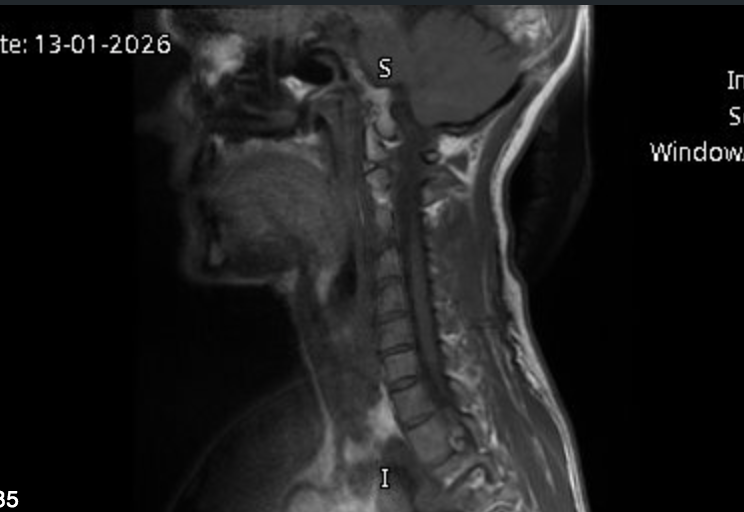
40 minutes of hands-on treatment with the osteopath gave me relief and a likely root cause of the pain, which was later confirmed by an MRI scan.
While online consultations take immediate pressure off GP surgeries, I believe in-person consultations are vital for effective healthcare, and in the case of musculoskeletal issues, touch is crucial.
So often clients come to me when the healthcare system hasn’t been able to help, and report that not once had someone actually felt the area in pain. Palpating for tension, heat, pain and range of motion provides essential information.
4. Months of micro-traumas can be as damaging as one major trauma
On feeling my neck, my osteopath asked whether I’d been in a car accident. Thankfully, I never have been, which begs the question, what then caused the disc in my neck to herniate?
Restrictions in fascia can occur through habitual movement. My job involves flexion in my upper body, and my shoulders and head are generally in a forward position. This isn’t a bad thing, however to account for this, I should spend more time releasing tension across the chest, arms and shoulders.
I was aware of tightness in my neck and chest, and aware that my table height was a touch low for me, meaning I was leaning forward further when working. I didn’t get around to fixing these things, adding a little more tension and strain to my neck every day, until it could no longer hold it.
Fascia has tensile strengths of up to 2000lb per square inch, so when restrictions form and that tissue tightens, it has the potential to cause serious damage to surrounding tissue (including intervertebral discs). Modern lifestyles and technology mean that the majority of us hold tension in our chest and shoulders, as they support the weight of the head looking forward at screens. We could all do with more care in these areas.
5. Modern medicine is wonderful but has limitations
Within 20 minutes an MRI scan showed a detailed image of my neck, confirming a herniated disc and the cause of the pain I was feeling. I was able to get a self-funded scan within a week via referral from my osteopath.
I was offered several medications that could block the pain far better than the natural options I’d been using. Sometimes sleep has to take priority.
However this scan doesn’t show fascia, and the tension I know is present in the front of my body, and the likely cause of the strain on my neck. In fact “the cause” wasn’t really discussed, other than a symptom of my age. Treatment offered was physiotherapy once out of pain, or possible surgery. Osteopathy and Myofascial Release were dismissed, although the GP hadn’t even heard of the latter.
I know that by addressing the fascial tension in the upper body, and being more mindful of my posture while working, will lessen the strain on my neck. Combined with yoga, Pilates, and heat treatment (weekly saunas here we come), I can help the tissue stay soft, supple and flexible.
The conventional healthcare system was excellent for diagnosis and pain relief, but treatment suggestions were vastly inadequate for this injury.
6. Childhood injuries can affect us decades later
As well as the disc injury, the MRI scan showed.a benign vertebral haemangioma. Nothing to worry about, however on seeing this my Myofascial Release therapist also asked whether I’d sustained a neck injury in the past. The only thing I could think of was a blow to the head by a see-saw when I was five, that would’ve sent a huge force through my neck. During the session, I suddenly became nauseous, and a memory surfaced of falling down the stairs as a teenager, hitting the back of my head on the last step causing immediate vomiting.
Though decades have passed, the fascial restrictions and tension created by those experiences were still in my body. Myofascial Release helped my body to work through and let go of this trapped energy, through a process we call unwinding. After six weeks of not being able to lie on my front because of the pain, my body was finally able to relax.
7. The body is amazing
A month and a half on, and pain levels have decreased drastically. I’m finely attuned to the signals from my body and reposition myself accordingly when the C7 nerve starts grumbling. It’s forced me to be hyper present as I work, knowing my body has to be at ease for me to give effective treatments. Each day my body is healing itself.
It’s easy to put off self-care when we feel well, but we shouldn’t wait for pain before looking after ourselves. To support the healing process, I’ll be doing at least 10 minutes of stretches a day, more gentle movement, committing to Pilates and yoga classes, taking regular sauna, and generally slowing down.
The body is always communicating. Our job is to listen. That’s not to say that if we get ill or are in pain, it’s our fault. As one of my teachers, John Barnes says, “without awareness, there is no choice”. Pain gets our attention, and with awareness of our patterns and habits (which will have served us to some degree) we can choose a different way.